Overview
- Having learned about Simple Harmonic Motion, in this unit, we extended from our knowledge and focused on exploring the WAVES. Our discoveries include the types of waves, wave properties, wave speed, superposition of waves, medium boundaries, and standing waves.
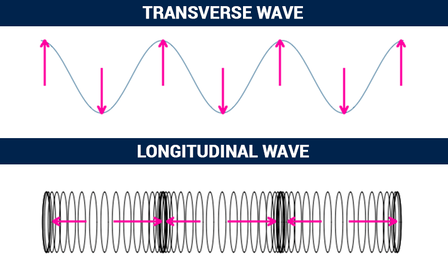 http://thescienceinfo.com/differences-between-transverse-and-longitudinal-waves/
Wave Investigations
- Definition
- Wave - an oscillation that transfers energy
- Longitudinal Waves V.S. Transverse Waves
- Longitudinal Waves: also known as compression waves; the oscillation is in the same direction, or parallel to the movement of the wave itself
- Examples: pressure waves, sound waves
- Transverse Waves: the oscillation is perpendicular to the motion (left or right)
- Examples: rope waves, light waves
- Longitudinal Waves: also known as compression waves; the oscillation is in the same direction, or parallel to the movement of the wave itself
- Mechanical Waves V.S. Electromagnetic Waves
- Mechanical Waves: a disturbance of matter that travels along a medium
- Examples: string waves, sound waves, water waves ...
- Electromagnetic Waves (not really important here)
- Examples: light waves, radio waves
- The important thing to know is the difference between them
- Mechanical waves have to travel through a medium
- Electromagnetic waves do not need a medium to travel
- Mechanical Waves: a disturbance of matter that travels along a medium
Wave Speed
- Equation
- Wave Speed = Wavelength * Frequency = Wavelength / Period
- v = λƒ = λ/T
- Note that the equation tell us that wave travels in a constant speed
- Wave Speed = Wavelength * Frequency = Wavelength / Period
- The speed of a wave is only dependent on the medium it is traveling through and nothing else
- (changes in the wavelength and frequency does not affect wave speed because if you double the wavelength, the frequency will have to be halved, so it does not affect the wave speed over all)
- Helpful Video
Wave Properties
- Wave Terminology
- Wave Speed (v) - speed at which the wave disturbance moves; depends only on the properties of the medium.
- Period (T) - the time interval for one complete vibration of a point in the medium any where along the waves. [Unit - sec]
- Frequency (ƒ) - the number of vibrations per second of a point in the medium as the wave passes. [Unit - Hz]
- higher frequency = higher pitch
- higher frequency = higher pitch
- Amplitude (A) - the maximum displacement of a point of the medium from its equilibrium position as the waves passes.
- Longitudinal waves - compare the highest density to the lowest density ares of the compression
- Transverse waves - measure the maximum displacement from equilibrium
- higher amplitude = louder sound
- Wavelength (λ) - Distance between adjacent maxima or minima of a wave.
- Crest - Highest point on a transverse wave. Also called the peak.
- Trough - Lowest point on a transverse wave.
 self-created
- Amplitude & Energy
- The amplitude of a wave and the amount of energy transferred are directly related; a greater amplitude means a great amount of energy that is being transferred through the wave
- The higher the crest, the lower the trough, the more energy there it
- Wave Period & Wave Frequency
- T and ƒ are always the reciprocal of each other
- T = 1/ƒ
- ƒ = 1/T
- Wave Speed & Medium
- Wave speed is a property of the medium, which depends on the density and tension of the material
- equation: V string = √(Tension of the string / mass density) = √(T/µ)
- According to the equation above, if you increase the tension of the medium, the speed of the wave increases as well
- Reflection of Waves & Medium Boundaries
- When a wave reaches the wall of the container or the end of the Slinky or rope, it reflects off the end and moves in the opposite direction
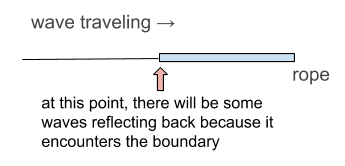
- Note that when a wave encounters any boundary between different medium, some of the wave is reflected back
- one example could be a rope that has two sections, one section is thinner than the other. Assume that a wave is transferring down the rope, when the wave hits the boundary where the rope get thicker, some of the waves are going to reflect back (see graph on the right)
- Here's a really cool video about Ruben's Tube to watch and relax
Superposition of Waves
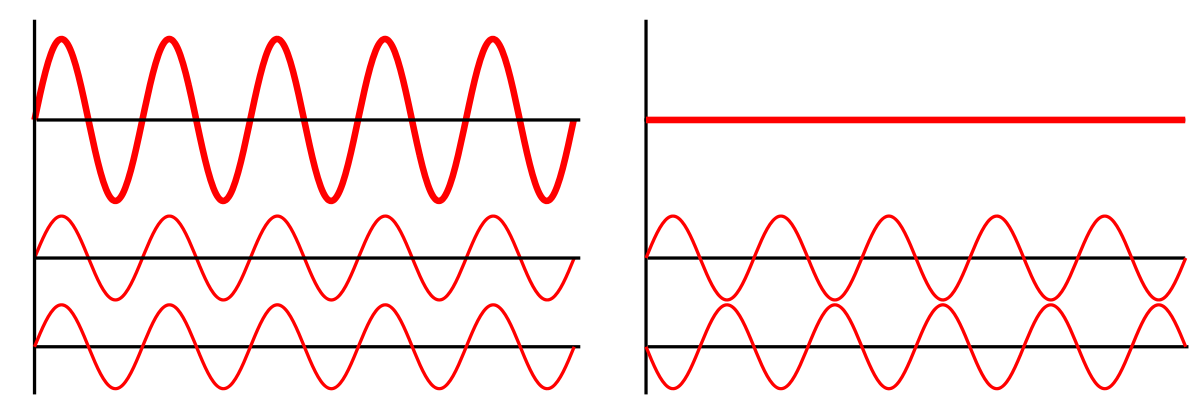
When waves interact with one another, there are two types of interference:
When waves interact with one another, there are two types of interference:
|
Constructive Interference
|
Destructive Interference
|
https://en.wikipedia.org/wiki/Wave_interference
|
Example Problem on Superposition Waves
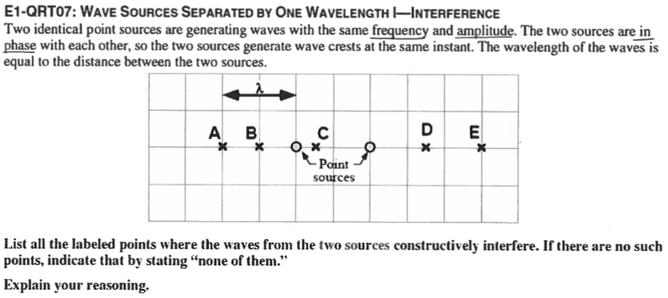
Mr.Frost, Problem Set #1
|
Answer: A, B, D, E Solution: Constructive interference happens when the path length to a point from the farthest source is a integer multiple of a wavelength larger than the path length to the point from the closest source. Thus, the two waves will be in phase with each other and hit the crests and troughs at the same time. And this occurs at point A, B, D, and E. |
Doppler Effect
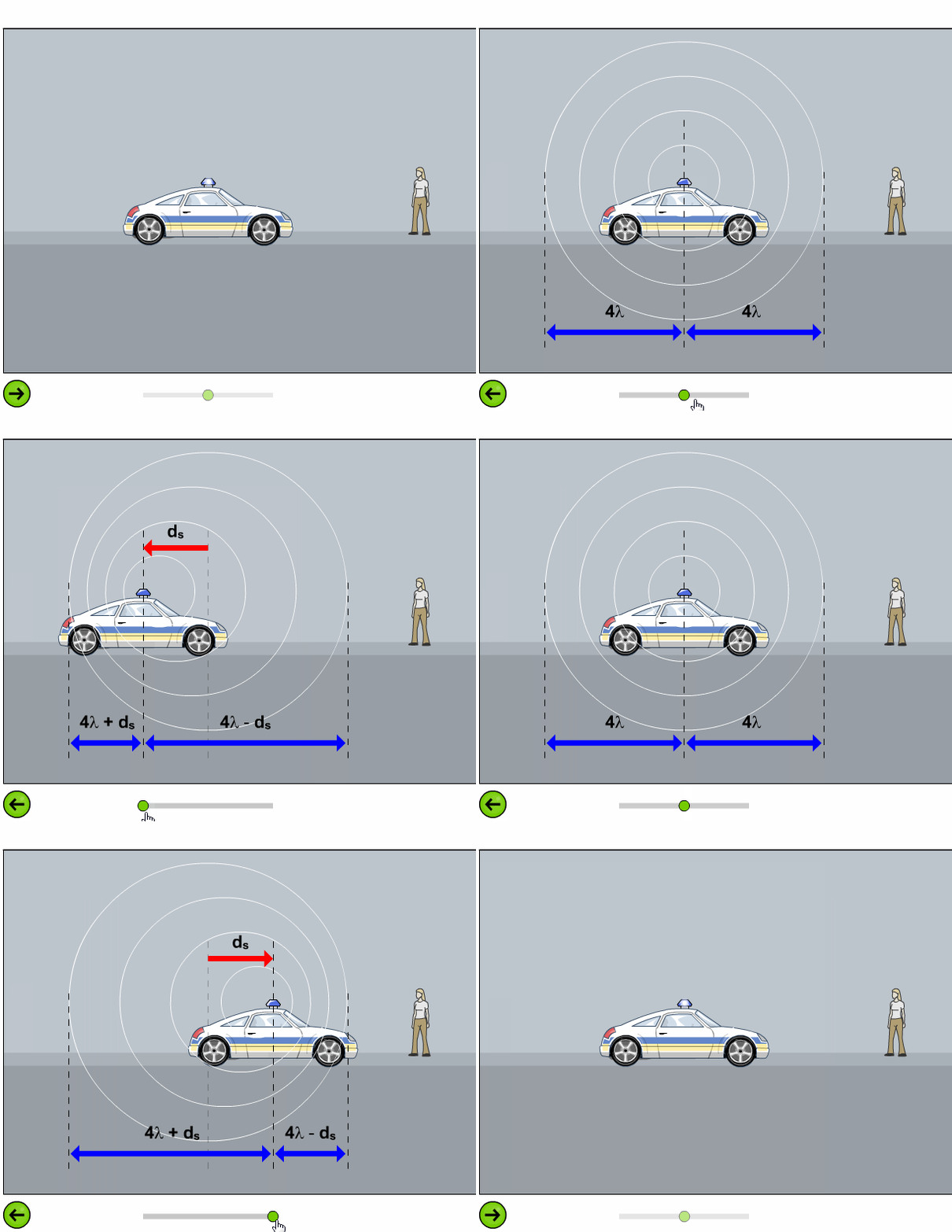 http://iamtechnical.com/explaining-doppler-effect
- The Doppler effect is the change in frequency or wavelength of a wave in relation to an observer who is moving relative to the wave source
- The Doppler Effect explains why we hear different pitches when a moving sound source is approaching to going away
- It is easier to visualize the waves when trying to understand the Doppler Effect
- when the source is approaches the person, causing the wavefronts to compress and therefore shortens the wavelength, resulting in an increase in frequency and eventually leads to an increase in pitch
- On the other hand, when the source is going away from the person, causing the wavefronts to become further apart and therefore lengthens the wavelength, resulting in a decrease in frequency and eventually leads to a decrease in pitch
 https://gifimage.net/standing-wave-gif-13/
Standing Waves
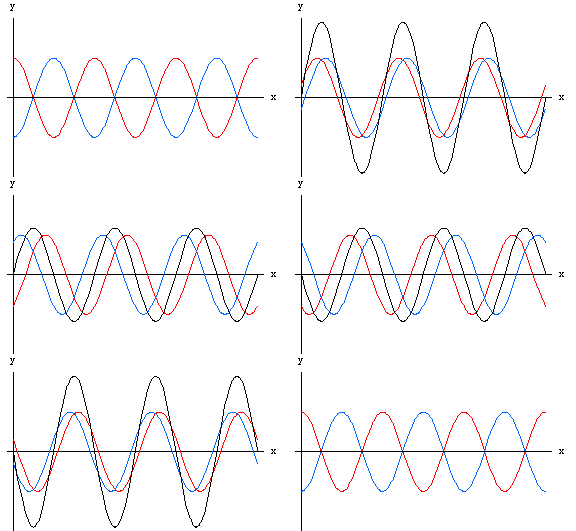
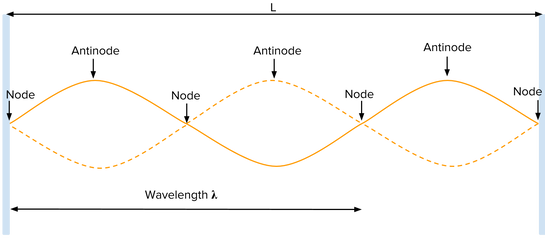
- Standing waves are waves which appear to be vibrating vertically without traveling horizontally. Created from waves with identical frequency and amplitude interfering with one another while traveling in opposite directions
- In the gif on the right, the black wave is the standing wave that is composed by the blue and red waves; it is easy to tell that both blue and red waves have the same frequency and amplitude but just traveling in opposite directions
- Note that standing waves are actually traveling
https://www.khanacademy.org/science/ap-physics-1/ap-mechanical-waves-and-sound/standing-waves-ap/a/standing-waves-review-ap
|
|
|
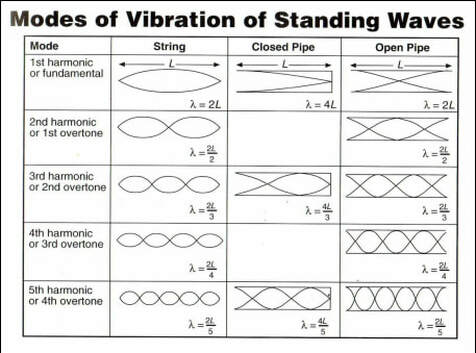
Standing waves are closely related to how the music instruments function. In this unit, we explored two different situations of sound waves:
We also explored harmonics.
The chart on the right summarizes our findings --> |
http://tghsl3physics.weebly.com/standing-waves.html
Speed of Standing Waves & Frequency
|
|
|
|
|
Physics & Guitar🎸 |
|
Speed of Standing Waves
Summary - The wavelength depends on the wave speed and frequency, and the velocity depends on the string's tension and linear density.
- Equation - v = √(T/µ)
Summary - The wavelength depends on the wave speed and frequency, and the velocity depends on the string's tension and linear density.
|
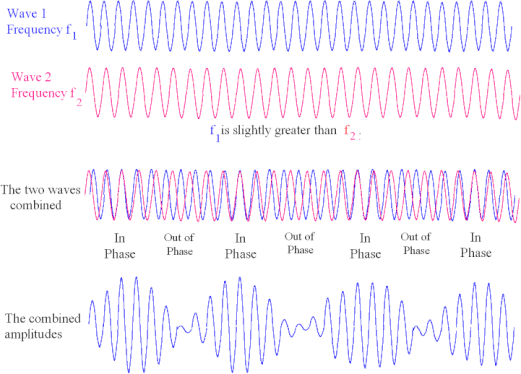
Beats
|
https://www.pinterest.com/pin/830773462485679748/?lp=true
|
Quick Review of the Unit
Widget is loading comments...
